
By now you’ve seen the pattern. Growth slows not because your sales team is underperforming, but because the early stages of the buying journey are not doing their part.
When prospects don’t hear about you consistently, don’t understand you clearly, or don’t come in ready for a real sales conversation, your team has to cover too much ground. They end up responsible for awareness, interest-building, education, qualification, and closing. That is too much weight on one part of the system.
The answer is not more activity or more pressure. The answer is building a simple go-to-market system that supports each stage of the buying journey so sales can do what they do best.
But there is one piece that comes before all of that. A piece only the CEO can provide.
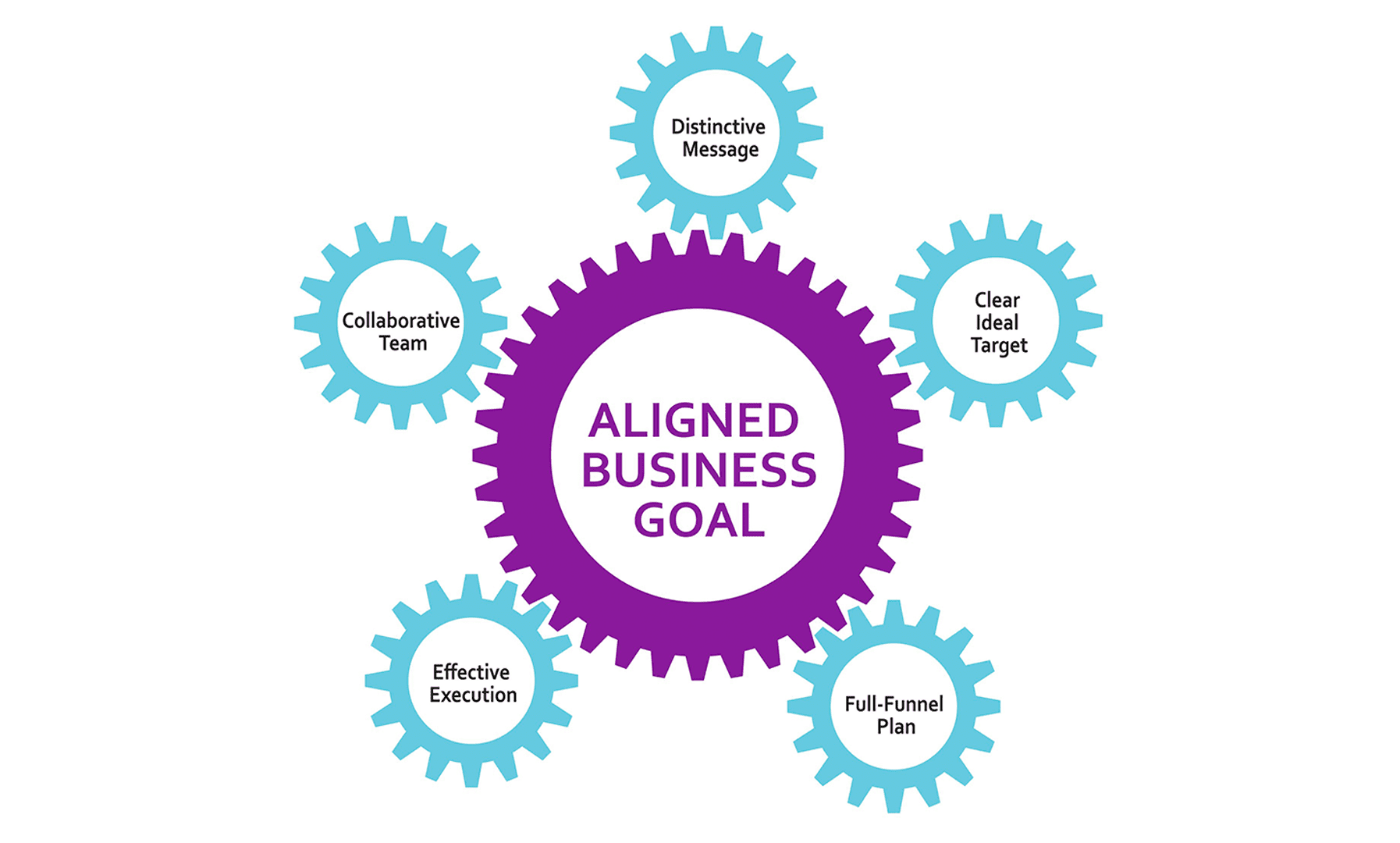
The System Only Works When the CEO Sets a Clear Growth Goal
In many mid-market companies, the growth goal is either unclear, constantly shifting, or understood differently by each part of the organization. When that happens, sales focuses on one thing, marketing focuses on another, and operations prepares for something else entirely.
Before you can build a strong go-to-market system, the CEO must set:
a clear growth goal
a clear definition of success
a clear direction for the type of customers you want to attract and keep
This clarity is what aligns sales, marketing, and the rest of the team. It’s the starting point for every part of the buying journey. Without it, the system becomes reactive. With it, the system becomes predictable.
How To Build A Go-To-Market Growth Engine
Once the growth goal is clear and shared across the organization, the system can be built in a practical, mid-market-friendly way.
1. Start with the right Ideal Target.
This step sounds simple, but most companies skip it or keep it vague. When you know exactly who you serve best, everything becomes easier:
Your message sharpens.
Marketing knows who to reach.
Sales spends less time with wrong fit prospects.
Your team focuses on the conversations that matter.
This clarity is the foundation of the entire system.
2. Define a distinctive message.
Make sure prospects understand the basics before they reach sales. Your best salespeople should not be spending half of their day explaining what your company does. That is early stage work and it slows everything down.
You do not need a complicated plan to fix this. You need simple, clear communication that answers the questions prospects ask first:
What do you do?
Who do you help?
Why does it matter?
What problems do you solve?
When this information is easy to find and easy to understand, the right prospects come in prepared and ready to talk. This alone can transform your sales conversations.
3. Align a collaborative team.
Strengthen the handoff between marketing and sales. In a healthy go-to-market system, marketing and sales each play their part.
Marketing helps prospects:
- Hear about you
- Understand you
- See potential fit
Sales helps prospects:
- Explore solutions
- Evaluate your approach
- Make a decision
The handoff between the two is where growth often breaks down. If prospects reach sales too early, sales does too much explaining. If they reach sales too late, opportunities go cold. If the handoff is inconsistent, so are your results.
You do not need software to fix this. You need agreement on when someone is ready for sales to step in.
Marketing and sales should align on:
- What readiness looks like
- What information a prospect should have
- What signals show real interest
When this is clear, the handoff becomes smoother and more predictable.
4. Build a full-funnel plan.
Create simple routines that support each stage of the journey. This is where companies often overcomplicate things.
Your routines do not need to be heavy or formal. They just need to be consistent. Examples:
For Building Awareness
- Share useful information regularly.
- Show up where your right customers already are.
- Make it easy for people to understand what you do.
For Increasing Interest
- Provide simple tools that help prospects explore independently.
- Answer common questions upfront.
For Gaining Commitment
- Give sales clean, prepared conversations so they can focus on advancing real opportunities.
For Building Relationships
- Stay connected to existing and past customers so they think of you when a new need arises.
These routines do not require new people. They require intention and consistency.
5. Ensure effective execution.
Review the entire system regularly, not just the sales pipeline. If you only look at the pipeline, you are only looking at the middle of the system.
A complete review includes:
Are the right people hearing about us?
Are we creating interest with the right prospects?
Are prospects coming in prepared?
Is sales spending most of their time in real sales conversations?
Are customers staying and expanding?
This gives you visibility into the entire journey, not just one part of it. Small adjustments then keep growth steady.
Next Step
A strong go-to-market growth engine does not replace sales. It makes sales far more effective.
When marketing supports the early stages, sales steps in at the right moment, and the CEO provides clear direction on growth, the entire company moves in the same direction.
Every conversation improves. Pipelines stabilize. Close rates rise. Growth becomes predictable.
You do not need to overhaul your company to get there. You need a clear growth goal and a system where each part of the buying journey has the support it needs to do its job.
Keep Reading
If this was helpful, you may find these related articles valuable.
If Your Pipeline Isn’t Predictable, It’s Not a Sales Problem
Why Your Growth Engine Breaks Down Before Sales Even Gets Involved
To save or share this article, download a copy below.